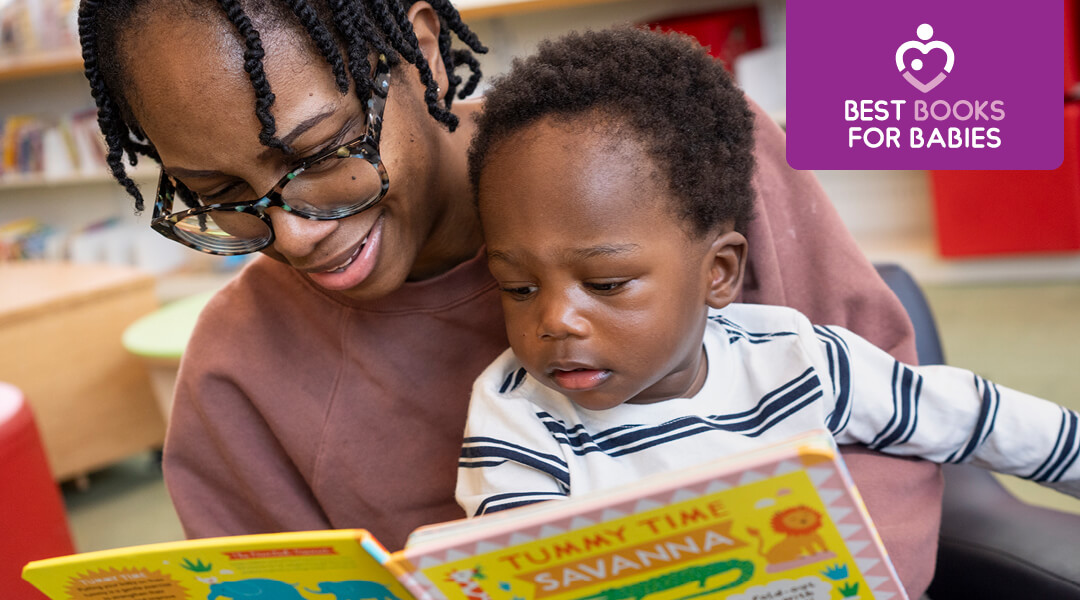
Did you know that it’s never too early to start sharing books with your baby? Research tells us that the first three years of brain development are critical. When caregivers read and speak to babies, the speech and language parts of babies’ brains are stimulated and develop.
But what to read? Not surprisingly, individual babies and their caregivers will have their own preferences. But there are some types of books that really appeal to babies.
 Books with simple black against white pictures like Whose Eyes? by Kristina Jones and Whose Nose? by Kristina Jones are easiest for babies ages birth to six months to see. Young babies also like patterns.
As they grow a little bigger, sturdy board pages and flaps offer the opportunity to interact with books themselves.

Get Dressed, Belly Button! by Lucie Brunelliére offers a chance for babies to grab on to differently sized pages that build upon one another as baby is dressed.
And babies love photographs of people’s faces, especially other babies. I Can Say Eat! by Stephanie Cohen and Lindsay Dale-Scott encourages language development using a combination of photos and speech bubbles.

Babies explore their world through touch and taste. Share books that offer different textures and sensations. The subtle textures on board pages in My First Black and White Book: Play! by Pascale Estellon are a great place to start.

Babies, like children (and lots of adults) learn through repetition. Be willing to read stories over and over again. But also give yourself permission to give some books a rest sometimes. Sharing a book that makes you cranky won’t necessarily be a positive experience for you or your baby.
We know that young children are wiggly! Do your best to share books when your child is relaxed but still alert. And don’t be afraid to put a book down and pivot to another activity. After all, even sharing just a page or two can be helpful—and fun. And reading throughout the day, rather than just once, helps to reinforce the idea that books are a part of everyday life.
Whether you are reading or engaging in other familiar activities, share new words every day. Point to pictures on the page as you describe them. Make connections to things you see and interact with in real life too.
Children learn from everything they experience. Talk, sing, read, write and play, at least a little bit, every day.
Best Books for Babies can be found online at bestbooksforbabies.org