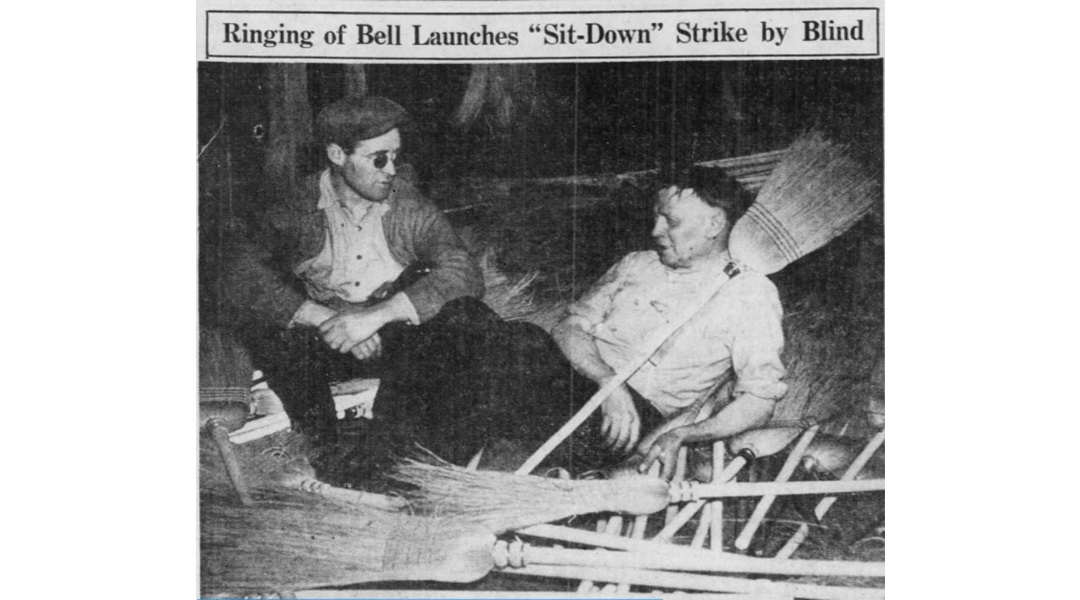
On March 1, 1937, broom maker Charles Scott scaled a massive bale of hay in a third-floor workshop of the Pittsburgh Blind Association (PBA) and rang a large bell. That was the signal to his coworkers that labor negotiations with PBA’s board of directors had failed. All work ceased, and a sit-down strike began. In celebration of Disability Pride Month, we’re looking into and providing an overview of this important labor strike.
The broom makers’ workshop was a “sheltered shop,” established by the PBA in 1910, “for the teaching [of blind people] various trades, such as broom and mop-making, carpet weaving, art fabric designing and weaving.” Intended to provide supervised, manual employment for individuals with disabilities, sheltered shops were established throughout the nation and were often extensions of schools for the blind, the deaf, and the physically handicapped. These shops provided employment to many who would not find jobs elsewhere; however, they also reinforced the segregation of disabled workers and were exempt from paying minimum wages. Responding to the broom makers’ demands, PBA management argued the workshop was not a workplace but a charity: it did not have the means to meet the workers’ demands for higher wages and better working conditions nor was it under any obligation to do so.
Congressman Matthew Dunn came from Washington D.C. to rally the workers on the first day of the strike. Blind since the age of 20, Congressman Dunn was a radical progressive serving his fourth year in the House of Representatives and was known as champion of the underdog. By 1937, the eighth year of America’s Great Depression, there were many underdogs and the broom makers’ strike would be one of 4,740 taking place within the calendar year. Dunn stood on a worktable to address the crowd of over 100 strikers. “I am with you on your strike,” the Representative declared, “except I don’t think you are asking enough.” Dunn was a board member of PBA but for the duration of the strike he would serve as the broom maker’s mediator, an important role to fill for strikers who were not affiliated with a union.
A sit-down strike requires workers to maintain a 24-hour presence in their workshop, temporarily taking over and blocking the means of production with their presence. The PBA broom makers settled into their shop for the long haul, using bales of broom straw as beds and relying on family and supporters to bring them food and other necessities. Negotiations continued, growing acrimonious as March dragged on. Congressman Dunn, by all accounts an affable man, grew flustered enough to threaten the PBA board with legal action if they did not relent and increase the broom makers’ wages.
In a year of labor strikes, the blind broom makers of Pittsburgh had captured the public’s attention, and the strike was covered both in and outside of Pennsylvania. It was national news when, at the end of March, strikers and management reached a settlement. The broom makers gained improved compensation for vacations and sick leave and secured their right to collective bargaining. They did not receive a wage increase.
Despite their limited wins, the PBA broom makers claimed a moral victory. The PBA board had initially treated the broom makers as wards of a charity; the monthlong takeover of the PBA workshop forced the board to negotiate with them as workers.
To learn more about how CLP celebrated Disability Pride Month, please visit Disability Pride Month 2025.
Sources
- Photo citation (above): Louis Stella and Frank Bakicka, two of the blind broom makers who occupied the Pittsburgh Blind Association workshop during a month-long sit-down strike. Pittsburgh Post Gazette, March 2, 1937
- “Work for the Blind,” Pittsburgh Bulletin Index, May 14, 1910, p. 7.
- “Analysis of Strikes in 1937, Prepared by Division of Industrial Relations,” Florence Peterson, Chief, Monthly Labor Review of the Bureau of Labor Statistics’ United States Department of Labor, May, 1938.
- “Whereas: Stories from the People’s House: The Mediator,” History, Art, and Archives of the House of Representatives, December 15, 2017, https://history.house.gov/Blog/2017/December/12-11-Photo-Mediator/